
Expert calls have been the centre of gravity of hedge-fund first-pass diligence for fifteen years. That is starting to break in funds that have noticed that the legacy workflow no longer fits the speed of their decisions.
The killer here is not the cost. A $1,500 call is easy to defend when the position is big enough, it is pocket change. The killer is the gap between when the question is alive, when an insight has value, and when the call gets run.
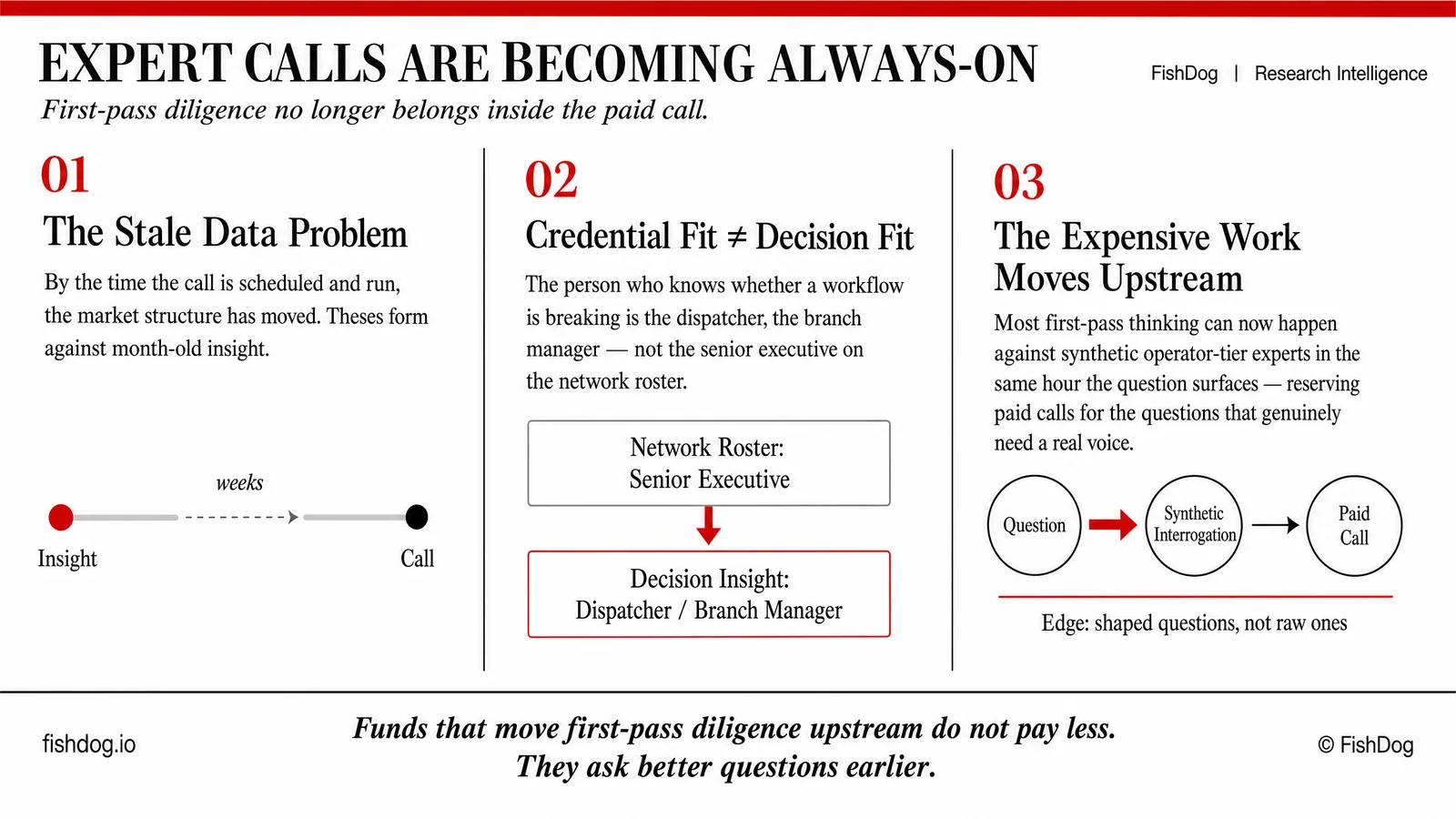
Five to ten days of scheduling delay is often enough for the market structure to have moved twice - the call lands, the insight is delivered, and the thesis it was meant to test has either already been sized by the competition or died on the desk.
The yield problem is worse than the delay
The second, and perhaps the harder problem, is yield. Every analyst I spoke to has the same story to share. The call that should have been useful and was not. The expert that was credible only on paper. The career arc looked relevant, the fee got paid, and nothing in the conversation changed the thesis even one iota.
The call was usually not useless because the expert was dishonest. The call was useless because credential fit and decision fit are two entirely different things. The polished senior executive, who is flattered by the invitation to join an expert call, can explain market structure beautifully - yet still be a long way from the operational detail the analyst actually needed.
The person who knows whether a workflow is breaking isn't in the C-Suite. It is usually a dispatcher, a branch manager, a procurement lead, a plant supervisor, a supplier rep, an office manager; somebody who is closer to the mess. But today's expert networks were not structurally designed to find that person at scale.
The cost gets worse the moment you start measuring it correctly. A $1,500 invoice for one call is easy to defend. But the same fund running three calls to find the one useful conversation is now paying $4,500 for a low-yield process, plus the analyst's hours of prep, follow-up, compliance review, note synthesis, and opportunity cost. What started as a $1,500 call now balloons into five figures and the thesis is still in limbo.
The question quality matters more than the call
The point I keep coming back to is question quality. The valuable hour on a call is the one spent answering questions that already matter to the thesis, not the one spent figuring out what to ask in the first place. Until recently there was nowhere else to do the question-shaping work except inside the call itself, so the call did both jobs at once and the final bill reflected it.
Enter synthetic expert calls, delivered by our platform. The analysts who get the most from a synthetic interrogation pass are not the ones running the most queries; they are the ones arriving with the load-bearing assumption already identified. The synthetic layer is not doing their thinking for them, it is clearing the work that gets in the way of it.
What changes when first-pass diligence stops taking a week
The shift we are watching in real time is not "AI experts replace human experts." That framing has always been wrong, and will always be wrong. The shift is in what counts as the first pass.
The old first pass was: scope a question, file a request, wait for scheduling, run a call, transcribe, then synthesize. Five to ten days was the normal timeframe. The result was maybe useful at the end of it, but often not. Then a second call had to be booked to recover the question the first call missed. The thesis that was being checked frequently formed against that timeline rather than because of it.
The new first pass is a different shape entirely. With FishDog, it is now possible to pressure-test a thesis in hours, not weeks. The analyst interrogates synthetic experts directly — the dispatcher, the branch manager, the plant supervisor, the procurement lead, the supplier rep, the operator-tier voices the human network was never going to surface in time. The platform generates a sourced packet from that interrogation: load-bearing assumptions, counter-thesis, operational drivers, leading indicators, gaps. Every claim is marked against a source. The packet is built to be checked, not trusted. For most operator-tier questions, this is the channel check — not a precursor to one.
Where a paid human call still earns its place — verification of a high-stakes claim, regulated decisions, the long-term relationship with a known operator — it lands later, sharper, and on a narrower set of questions. The fund that gets there first is not paying less; it is asking better questions earlier and dying off weaker theses faster.
What I would actually do
If I were running a research book today, the first question I would ask is not "should I keep buying expert calls?" The answer is yes, where they earn their place — verification, regulated decisions, ethnographic depth, the long-term relationship with a known operator. The deeper question is "what work am I doing in paid human calls that I should not be doing in paid human calls?"
Most of it, on inspection. Operator-tier questions, channel checks, early pressure-tests against the procurement lead or the branch manager — that work has historically only been available through expert networks, which is why the budget went there. Direct synthetic interrogation gives the analyst that access in the same hour the question surfaces. The paid calls that remain are the ones where the question genuinely needs a real voice, and they land sharper because the operator-tier work has already happened somewhere else.
The market is moving, often quietly, from rented human conversations toward direct interrogation of synthetic operator-tier experts, packaged into an artifact built for inspection. The funds that notice the move first will not simply save money — they will start every week with a one-week lead on every other fund.
Further reading
The product version of this argument is [Thesis Lab](/thesis-lab) — direct interrogation of synthetic operator-tier experts, channel checks in minutes, and the structured packet built for inspection. For validation context, see [FishDog's methodology and validation hub](/methods-validation).