Built for funds. Thesis Lab pressure-tests a thesis against synthetic expert cohorts before you commit time and budget to expert calls and diligence.
POWERED BY FISHDOG
Most synthetic-research pitches assume human research is ground truth. On the buy side, that baseline is already breaking in specific, familiar ways.
The same experts rotate across funds, so the edge converges. And a paid call can now be a non-expert with a chatbot running.
Panels skew toward people who value their time cheaply, and some agencies coach participants to pass the screener.
Just as fielding costs rise and the half-life of a tradable signal keeps shrinking. The "real human" baseline is itself noisy.
The usual way to build synthetic respondents is to write a few personas and prompt a model to act them out. That imports the author's assumptions and the model's tidy average. Thesis Lab inverts the order.
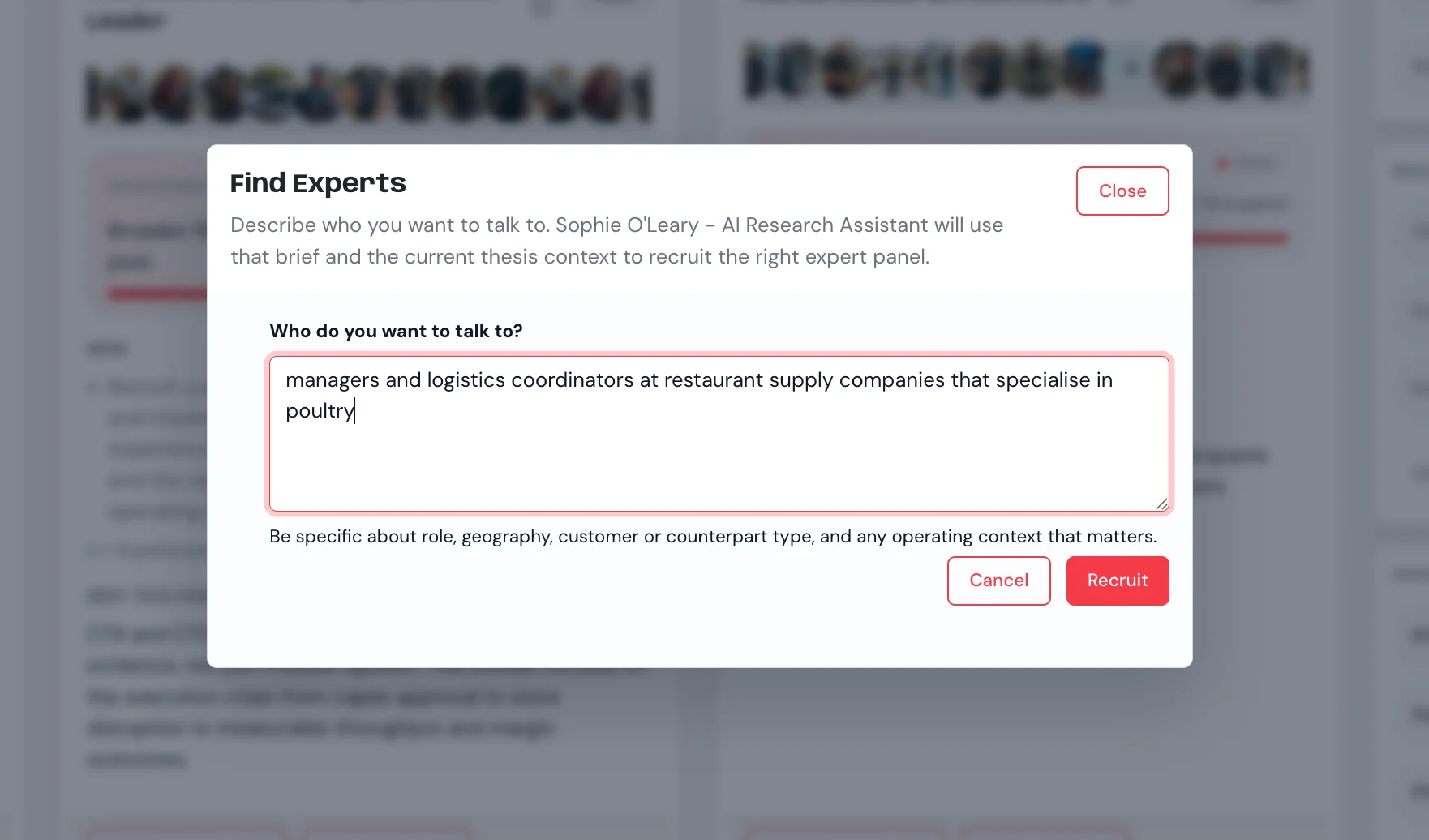
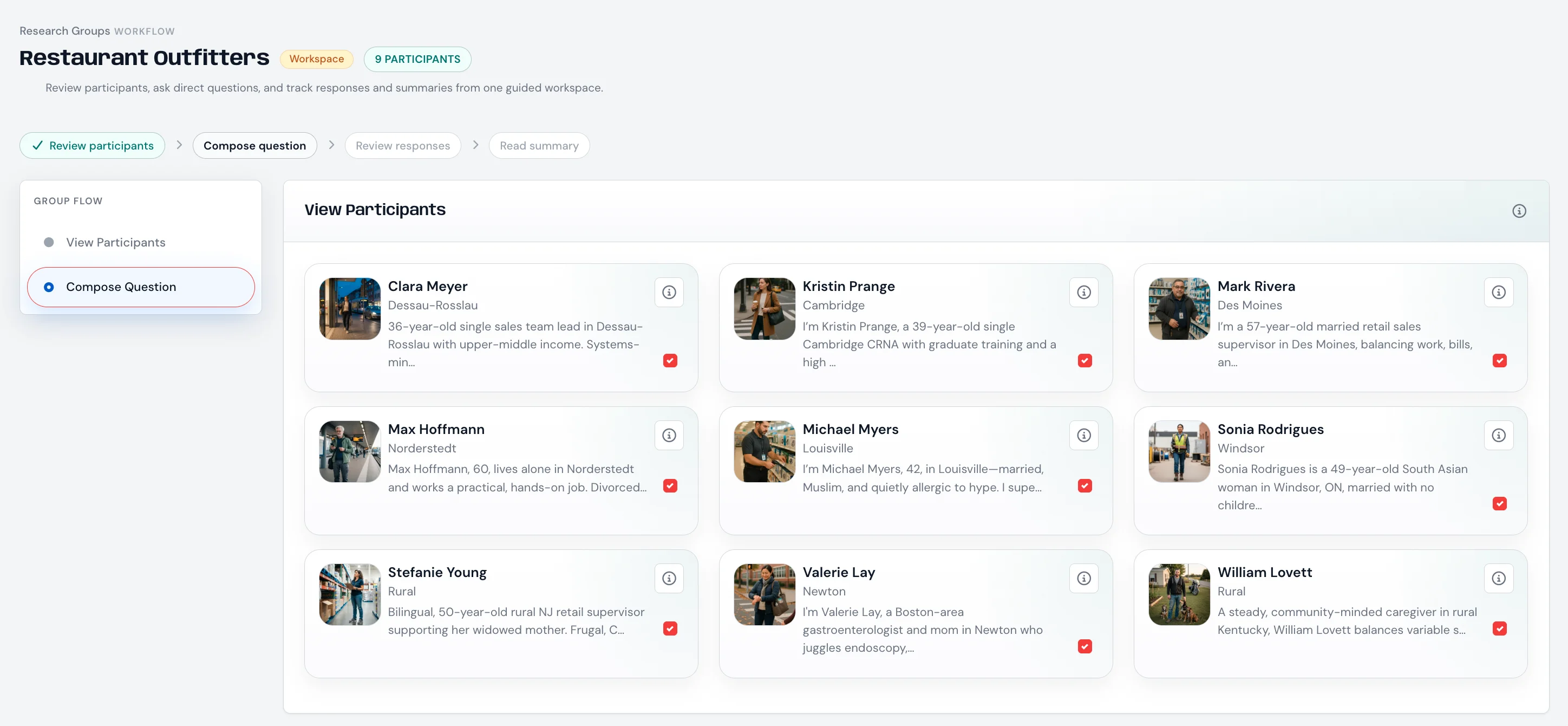
Recruit a cohort of CIOs at 250-to-500-person firms in a named vertical, without scheduling them one by one.
Ask any expert follow-up and "why" questions at volume. A fixed survey can't, without re-fielding.
Re-run waves without burning the panel. Consistency is controlled in software, not re-recruited each time.
Shape the hypothesis, find the questions worth a paid human hour, and walk in better briefed.
Get a fast read on a sector or cohort when fielding a human survey is too slow or too costly to justify.
Segment into a micro-population no human panel was ever recruited for, and probe it.
Re-run the same panel the same day to read the change, rather than waiting a quarter for the next wave.
See it run against two of your live questions.
Book a DemoWe don't ask you to trust one number. Thesis Lab is validated in layers, each against an external yardstick.
~1% average marginal error across selected demographic and labour-force marginals. The population is audited against the real one before a single opinion is elicited.
Graded against real-money events that resolve to fact. Strongest on technical and expertise-driven questions, which is exactly where the analyst value is highest.
~9% mean absolute error versus published human results, compared by demographic group where cross-tabs exist.
A standing benchmark against a published, federally-tracked series, continuously monitored for directional accuracy and drift. See the model check →
Read the reliability before the event resolves. Because every benchmark question is scored on the same 18 axes, a new question is matched to prior ones of similar shape, giving an expected reliability range while there is still time to act, not after the event settles. Full methodology available for diligence review.
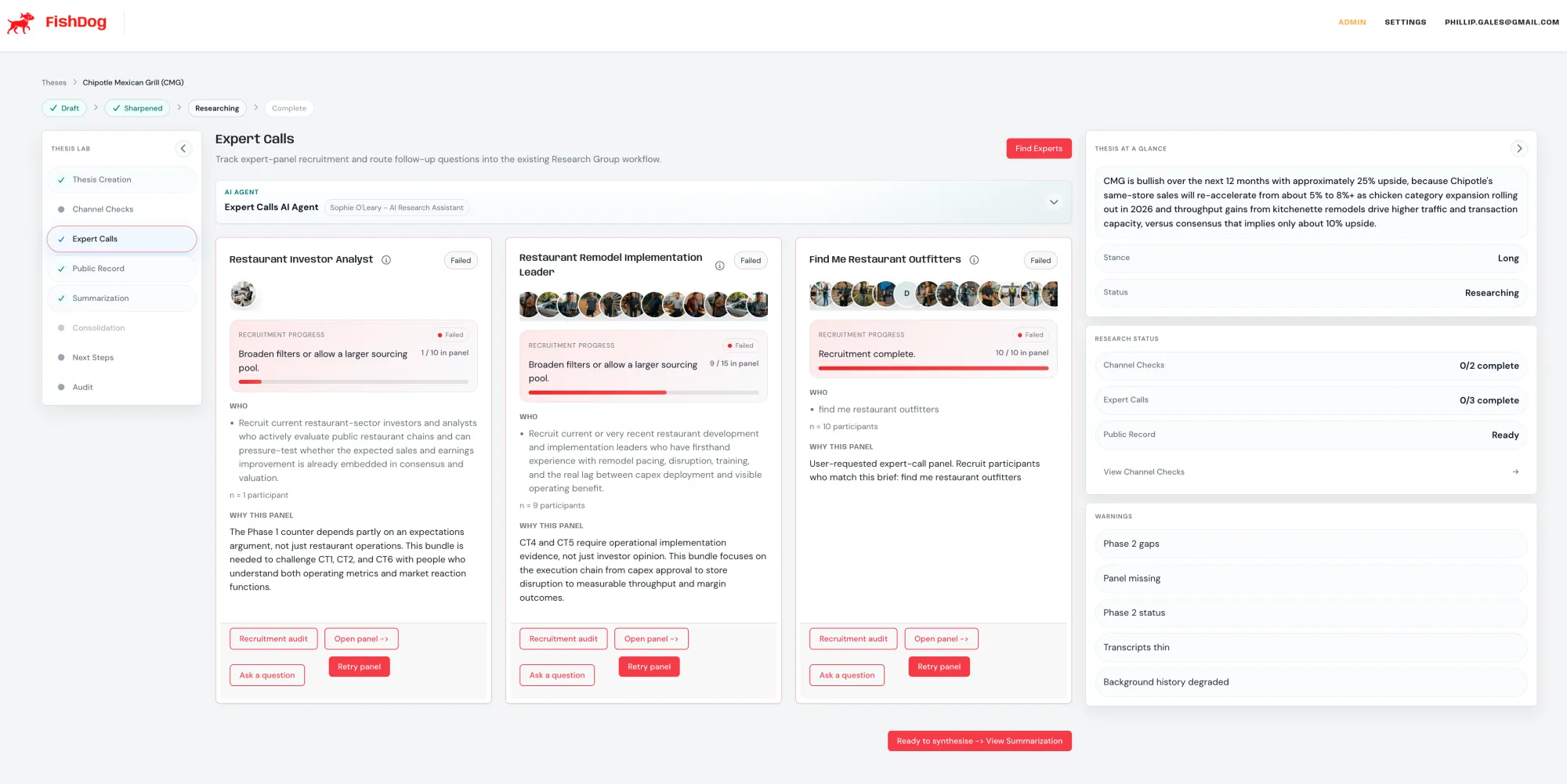
Thesis Lab will run synthetic expert cohorts and channel checks, then compare the outputs against your existing expert-network workflow.
Then you've hit the data-staleness wall - frontier models train to a fixed cutoff, so an earnings-cycle thesis gets tested against last year's world. Thesis Lab's cohorts are grounded in real census, occupational, and market data, refreshed every four hours. And because answers come from a calibrated population, you get the full distribution - outliers and disagreement included - not the consensus average a chatbot collapses to. Cohort design is inspectable and outputs are linked to sourced research packets - traceability an off-the-shelf chatbot can't give your diligence or compliance teams.
No - it makes them more productive. Expert networks give you depth from real people; Thesis Lab gives you breadth, structure, and repeatability first. You walk into the expert call with a sharper agenda, a better expert match, and the questions already framed - so the call you were going to book anyway returns far more signal.
We don't rest it on one number. Thesis Lab is validated in layers, each against an external yardstick: the population calibrates to Census and ACS microdata at roughly 1% marginal error, cohorts are scored daily against 18 real-money prediction-market axes, and outputs are benchmarked against Gallup, Pew, and the University of Michigan sentiment series. The full methodology is available for diligence review - we would rather you stress-test it than take any figure on faith.
Yes - that's the point. Cohorts are built from real census and occupational data across customer types, roles, regions, income bands, industries, and buyer segments. That includes the procurement managers, sales leaders, dispatchers, practice managers, and supplier reps expert networks tend to gatekeep - so you build the cohort the thesis needs, not just the experts a network can schedule. When a cohort is too narrow for the population to carry, we say so before anything runs.
It is designed to avoid MNPI solicitation by construction - synthetic cohorts have no insider knowledge to manage, log, or monitor. Cohort design is inspectable and every output is linked to a sourced research packet, so research provenance is auditable end to end.
The customer-facing brand is Thesis Lab. FishDog is the platform it is built on - "Powered by FishDog." Every contract, packet, and artifact you receive is Thesis-Lab-branded.
Signal from our synthetic populations, product updates, and the occasional hot take. No spam.