
Product Release

Polymarket events as a calibration source

FishDog adds a Polymarket integration that imports prediction-market events as calibration targets, runs recruited panels against them, and compares the panel's predictions to Polymarket's live pricing — falsifiable validation for synthetic personas.

4 March 2026

Feature
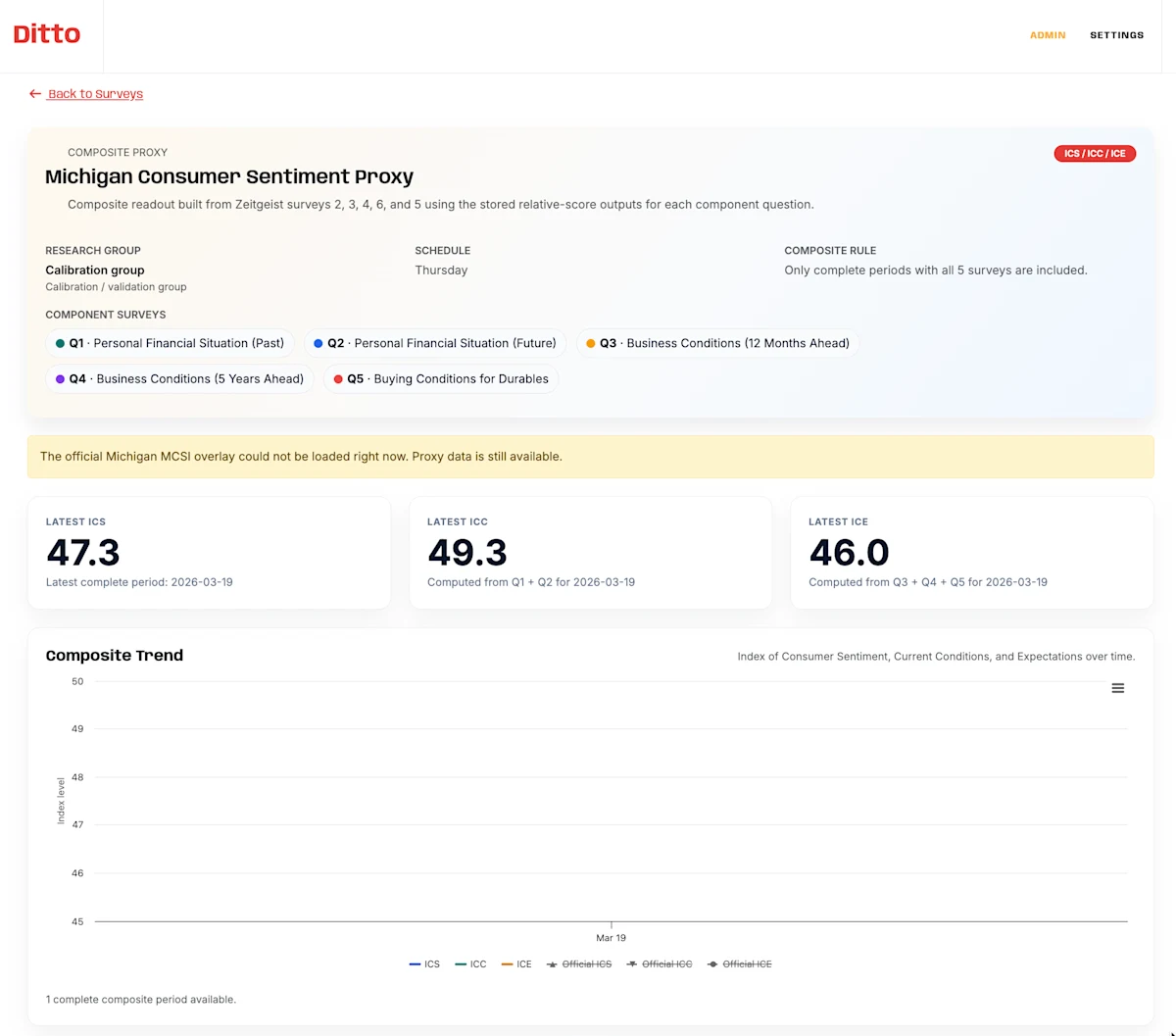
FishDog's Michigan Consumer Sentiment Proxy page, showing the live ICS, ICC, and ICE composite indices computed from a 100-persona panel.

Key Takeaways

  • Polymarket events can now be imported into FishDog as calibration targets, with suitability filters that remove very low-liquidity markets.
  • A recruited panel answers the imported question; the resulting distribution is compared against Polymarket's mid-market price at run time.
  • Validation metrics (calibration error, Brier-score components) are computed and persisted to a calibration store, so repeated runs build a track record.
  • Useful for research-validity work, for selecting panels by demographic composition, and for internal benchmarking of the persona model.
  • Follow-up on 18th April broadened the import selection and added pagination to the events gallery.

Synthetic personas are useful only insofar as their predictions track the real world. Polymarket — a real-money prediction market — is one of the cleanest external sources we've found for grading them.

The new Polymarket integration imports markets into FishDog as calibration targets. Pose a market's question to a recruited panel, collect their predictions, and compare the panel's distribution to Polymarket's live pricing. The result is a falsifiable test of how well a FishDog panel predicts real-world outcomes for a given category of question.

What's new

  • Polymarket event importer. Browse Polymarket events directly in FishDog, filter by category and resolution date, and import the ones that fit your validation work. Suitability rules filter out very low-liquidity or thinly-traded markets — those that aren't a useful calibration target.

  • Calibration runs. A recruited panel answers the imported question; the panel's distribution is compared against Polymarket's mid-market price at the time of the run. Validation metrics (calibration error, Brier-score components) are computed and persisted.

  • Calibration store. Repeated runs against the same market over time build a track record. Useful for showing that a panel's predictions on, say, US elections are calibrated within a known error band — or aren't.

When to use this

  • Research-validity work. When a customer wants evidence that FishDog panels predict realistically on a given category, this is the cleanest external grading available.

  • Panel selection. Different panels predict differently. Calibration runs help identify which panel composition (demographic mix, recruitment filter set) tracks markets in your category most reliably.

  • Internal benchmarking. We use the calibrated track record ourselves when refining the persona model.

Also in this release

A small follow-up shipped on 18th April broadened the import selection (more event categories, looser default filters) and added pagination to the events gallery, so importing from a larger Polymarket session takes one trip rather than several.

Full reference is in the API docs.

---

Synthetic personas are useful only insofar as their predictions track the real world.
A falsifiable test of how well a FishDog panel predicts real-world outcomes for a given category of question.
Useful for showing that a panel's predictions on, say, US elections are calibrated within a known error band — or aren't.

Frequently Asked Questions

What is Polymarket and why use it?

Polymarket is a real-money prediction market where users buy and sell shares in the outcomes of specific events. Mid-market prices on those shares give a continuously updated, money-backed probability estimate. That makes Polymarket one of the cleanest external sources for grading whether a FishDog panel's predictions track the real world.

How does the calibration comparison work?

An imported Polymarket event becomes a question put to a recruited panel. Each persona produces a probability estimate; the panel's distribution is compared to Polymarket's mid-market price at the time of the run. Calibration error and Brier-score components are computed and persisted.

Which markets can I import?

All Polymarket events are visible in the importer, filtered by category and resolution date. Suitability rules remove very low-liquidity or thinly-traded markets — those that wouldn't be useful calibration targets. The 18th April follow-up broadened the default selection and added gallery pagination for larger import sessions.

What are calibration runs useful for?

Three things: (1) research-validity work — demonstrating to a customer that FishDog panels predict realistically in their category; (2) panel selection — identifying which demographic compositions track markets best; (3) internal model benchmarking when refining the persona model.

Can I run repeated calibration runs over time?

Yes. Calibration results are persisted to a calibration store, so repeated runs against the same market build a track record. This is the right shape for showing that a panel's predictions are calibrated within a known error band over time, rather than just at one moment.

Release Tags

Data SourcesProduct Release

More Releases

Stay in the loop.

Signal from our synthetic populations, product updates, and the occasional hot take. No spam.